
In short
A dealer website is not a brochure. Its job is to show the current stock, answer the two questions every buyer has before calling (“what is my old one worth?” and “what will it cost me per month?”), and turn a visit into a conversation.
That is true whether you sell cars, agricultural machinery, trucks, boats, motorcycles or RVs. This article shows what we build into dealer websites, using a real project: Agrider, a machinery dealer whose site we designed and built, in five languages, with a valuation tool and a leasing calculator.
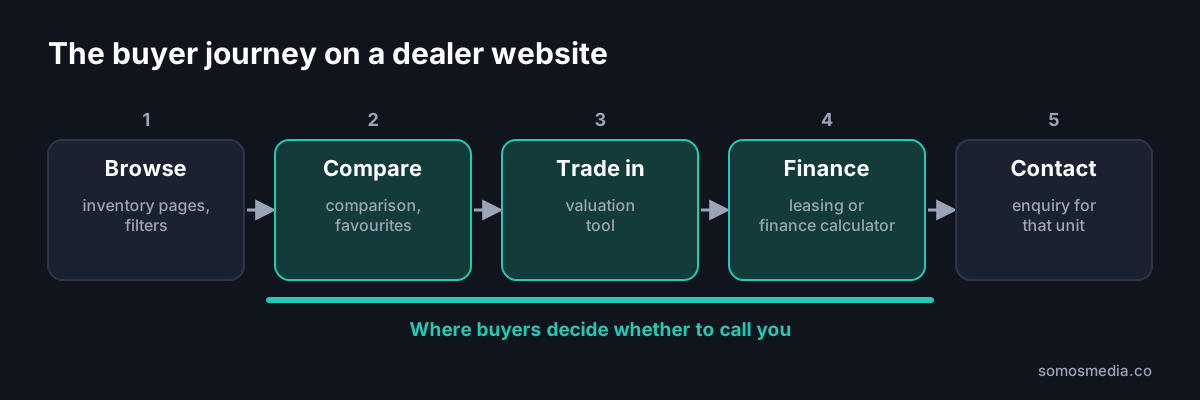
What buyers do on a dealer website
| Buyer step | What they look for | What the site needs |
|---|---|---|
| Browse | Is the model in stock, what condition, what price? | Inventory pages with photos, specs and price, filters by make, model, year and price |
| Compare | Which of these three is the better buy? | Comparison and favourites |
| Trade in | What is my current vehicle or machine worth? | A valuation tool that gives an honest estimate |
| Finance | What is the monthly payment? | A finance or leasing calculator next to each listing |
| Contact | Can I see it, test it, reserve it? | One clear enquiry form per listing, with the listing attached |
Most dealer websites cover the first and last steps. The middle three, compare, trade in and finance, are where buyers decide whether to call you or the next dealer.
1. Inventory pages that update themselves
Stock changes every week. If a person has to type every vehicle or machine into the website, pages go out of date, sold units stay online, and the team stops trusting the site.
What works instead:
- Import from the data you already have. XML feeds, dealer management system exports or spreadsheets. Agrider's stock is imported from XML and spreadsheet files instead of being typed in by hand.
- One page per unit, with its own URL. Photos, specifications, price, location, and an enquiry button that knows which unit the buyer is asking about.
- Category, make and model pages. These are the pages that rank in search. Agrider has brand and model pages for Claas, Fendt, John Deere, New Holland, Zetor and more.
- Sold units handled on purpose. A sold page or a “sold” label keeps the URL useful instead of returning an error.
- Automatic labels. On Agrider, the “new” label expires after seven days without anyone touching it.
- Marketplace exports. A daily XML export sends Agrider's stock to Agroinform, a Hungarian agricultural marketplace, so the website is the single source of truth.
2. A valuation tool for trade-ins
A trade-in valuation is the strongest lead tool a dealer website can have. The visitor gets something useful, and you get a contact who owns a unit and is thinking about the next one.
Agrider's free machine valuation builds its estimate from source-verified European market listings, corrects it for year and engine hours, and converts it at the ECB exchange rate. Owners can add up to four photos, and AI assesses the machine's condition and equipment from them. Try it on agrider.co.
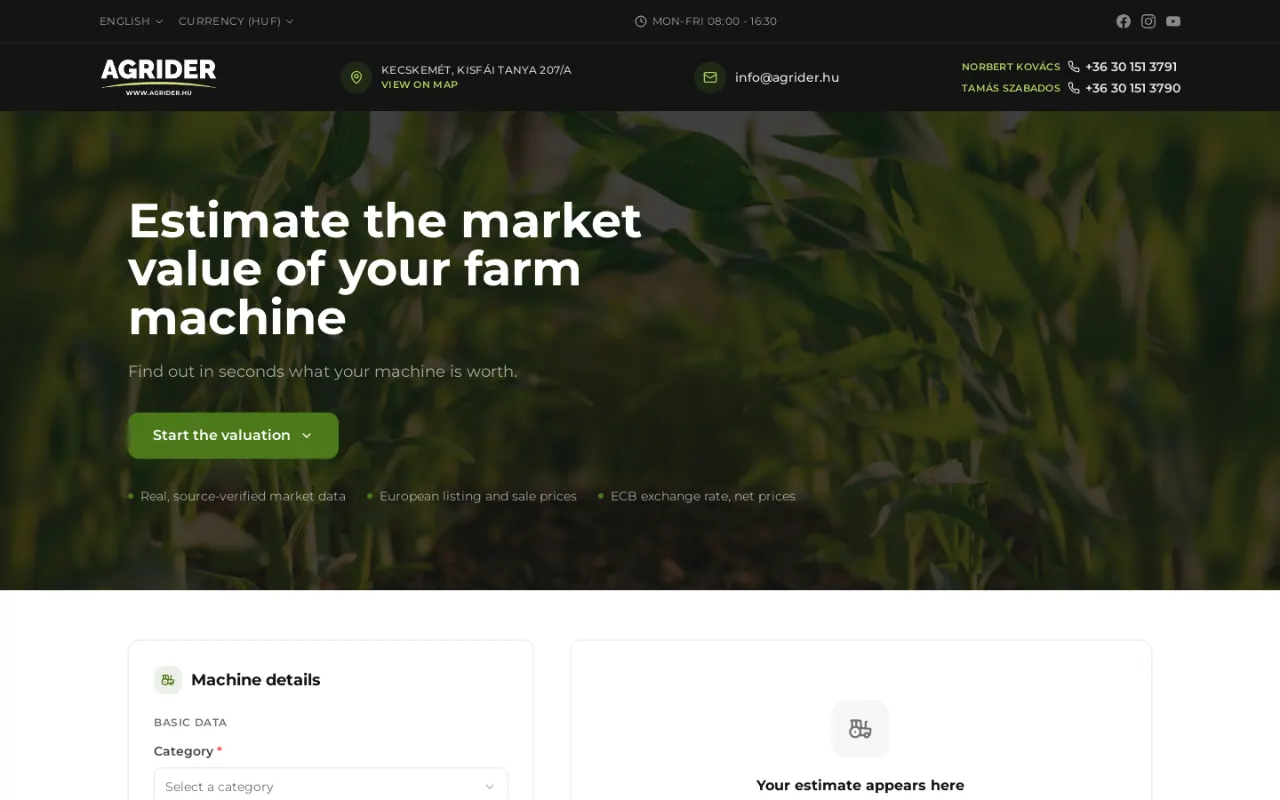
The English version of agrider.co. Screenshot: 19 October 2026.
What makes a valuation tool credible:
- Real market data, with the method explained in one sentence.
- A range, not a promise. The final price comes after an inspection, and the tool says so.
- Few required fields. Make, model, year and hours or mileage first; photos and contact details after the buyer sees value.
3. Finance and leasing calculators
Many buyers think in monthly payments, not list prices. A calculator next to the stock answers that question before the first call.
Agrider's leasing calculator shows the monthly payment and the total repayment, and links straight to a financing enquiry. For car dealers the same idea becomes a finance calculator per vehicle. Keep the assumptions visible (term, deposit, rate), and make it clear that the final offer comes from the financing partner.
4. Several languages, if your buyers cross borders
Used vehicles and machinery sell across borders. Agrider serves buyers in Hungarian, English, Romanian, Polish and Ukrainian. Each language has its own URLs, for example /en/leasing-calculator/ and /uk/kalkulyator-lizynhu/, with hreflang tags and a dynamic sitemap. Prices switch between HUF and EUR.
That adds up to about 410 machine pages per language and 2,463 URLs in the sitemap. Machine pages are translated by back-end functions, so a new unit appears in all five languages without a translator in the loop. Our article on hreflang tags in practice explains the technical side.
5. Trust signals where the decision happens
- Google reviews, financing options and trade-in on the homepage, as on Agrider.
- Real photos of each unit, not stock images.
- Location, opening hours and a named contact person.
- A knowledge base that answers buyers' questions. Agrider runs a blog and a knowledge base in all five languages.
Dealer website design checklist
- Stock imported automatically from your existing data.
- One page per unit, with photos, specs, price and a unit-specific enquiry.
- Filters by make, model, year, price and condition.
- Make and model pages written for search.
- Sold units kept online on purpose.
- Trade-in valuation with an honest range.
- Finance or leasing calculator next to the stock.
- Language versions with their own URLs if you sell abroad.
- Marketplace exports from the website, not the other way around.
- Search Console and enquiry tracking from day one.
Template, dealer platform or custom build?
Vehicle dealer platforms and templates are fine if you sell one type of stock in one country and your dealer management system already feeds them. A custom build pays off when you need your own valuation logic, several languages, several stock sources, or tools that set you apart from every other dealer using the same template. Our guide on template vs custom websites goes into the trade-offs.
Frequently asked questions
What should a dealer website include?
An inventory that updates from your data, one page per unit with photos, specs and price, filters, a trade-in valuation tool, a finance or leasing calculator, clear enquiry forms, and reviews and contact details where buyers decide.
Does this work for car dealers, not only machinery?
Yes. Our example is a machinery dealer, but the structure is the same for car, truck, motorcycle, boat and RV dealers: stock pages, trade-in, finance and enquiry. Only the data fields and the valuation inputs change.
How much does a dealer website cost?
It depends on the number of stock sources, languages and tools. A full breakdown of website costs is in How much does a website cost in 2026?, and we give a fixed, itemised quote after a short call.
Further reading
- Agrider case study
- Multilingual website: what a 5-language site really needs
- Conversion optimization: how to sell more from the same traffic
- Template or custom website?
Planning a new dealer website? See our web development services.