
In short
SaaS development means building software that customers sign up for, use in the browser and pay for monthly. The code is only part of it. A SaaS product also needs accounts and roles, subscriptions and trials, onboarding, emails, data that stays separate per customer, and a way to ship improvements every week without breaking anything.
We build SaaS products for clients, and we run two of our own: DogDietLab, an AI nutrition app for dog owners, and Vistobi, an SEO assistant for websites and online stores. This article is what those two products taught us, written for founders and companies choosing a SaaS development company.
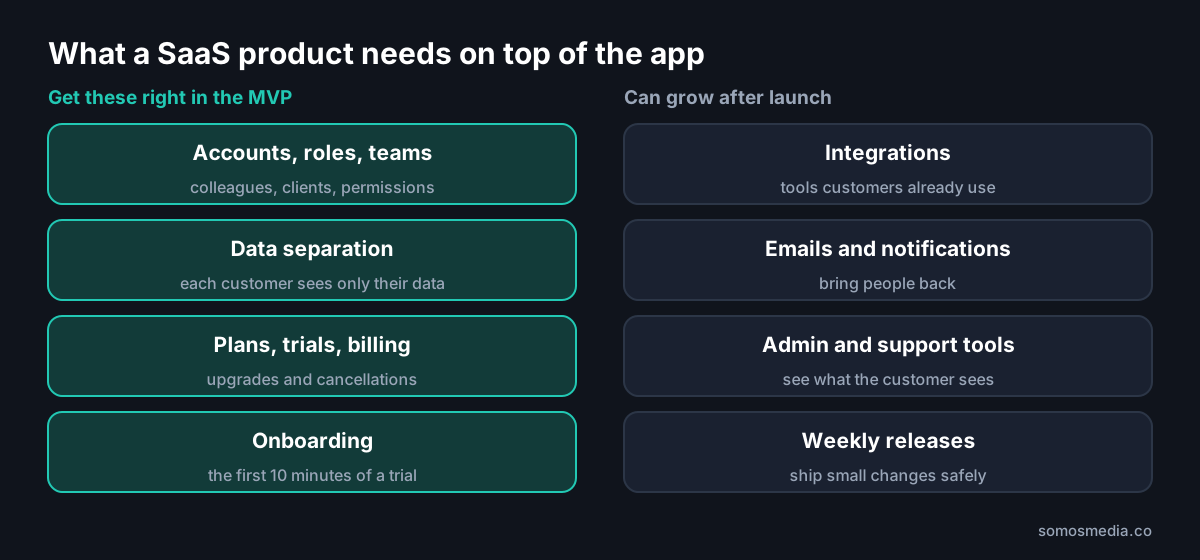
What a SaaS product needs on top of “an app”
| Part | Why it matters in SaaS | What goes wrong if it is missing |
|---|---|---|
| Accounts, roles, teams | Customers invite colleagues; agencies manage clients | One shared login, no audit trail |
| Data separation | Each customer only ever sees their own data | The most serious bug a SaaS can have |
| Plans, trials, billing | Revenue, upgrades, cancellations | Manual invoicing, lost trial users |
| Onboarding | The first 10 minutes decide whether a trial converts | Sign-ups that never come back |
| Integrations | Your product reads data from tools customers already use | Customers copy data by hand, then leave |
| Emails and notifications | Bring people back when something needs them | The product is forgotten after day one |
| Admin and support tools | You can see what a customer sees and fix it | Every support ticket becomes a developer task |
| Release process | New features weekly, safely | Fear of shipping, slow product |
A SaaS MVP does not need all of this at full depth. It needs the first four done properly, because they are expensive to change later.
Example 1: DogDietLab, an AI SaaS in 12 languages
DogDietLab tells dog owners exactly what and how much to feed their dog, based on breed, weight, age and health. It is our own product, so every decision and every mistake was ours.
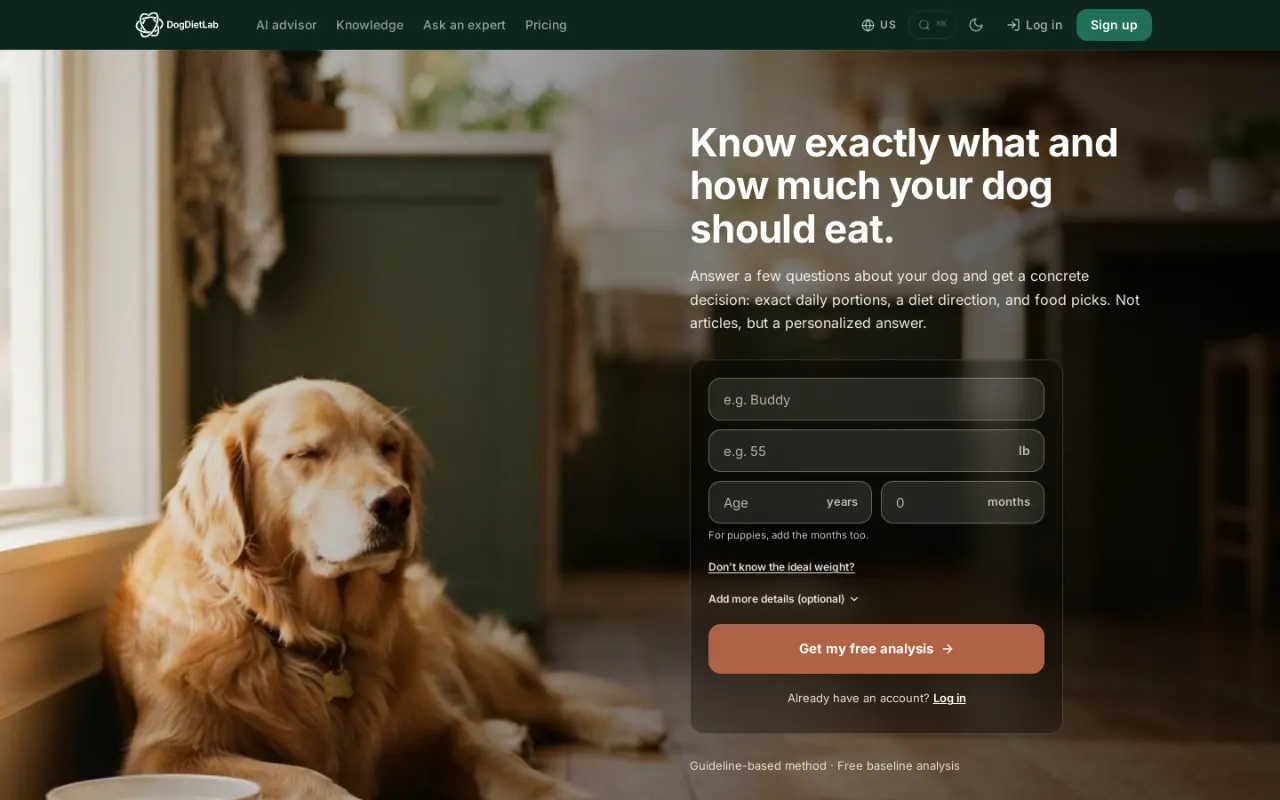
The English version of DogDietLab. Screenshot: 19 October 2026.
How it started. The core flow was a free two-minute analysis: a status score, an exact daily portion and a food recommendation. That flow proved that dog owners would use it. Accounts, a daily log, an AI advisor and a Pro subscription came on top.
What we built first. Before any screen, we modelled the data: Dog, DailyLog, DietRecommendation, Owner and DietitianReview. In SaaS the data model decides almost everything else: permissions, reports, what can be sold in which plan.
The AI part. The AI advisor runs on Gemini, and its recommendations go through a review step by nutrition specialists. We did not let a language model give health advice on its own.
What it looks like today:
- The first working version took about two weeks with one developer. With a classic stack we estimate two to three months.
- At launch: about 80 components, 12 back-end functions and 9 data types.
- Today: 24 regional versions in 12 languages (for example en-us, de-de, fr-ca and pt-br) and 4,375 URLs in the sitemap.
- A new feature typically goes from idea to live in two to four hours.
Example 2: Vistobi, a SaaS we built for our own work
Vistobi grew out of a routine. We run Melini webshops in four countries, and every week someone had to open four Search Console accounts, four Merchant Center feeds and four sets of rankings, then decide what to fix. We automated that routine for ourselves, then turned it into a product.
What makes it a real SaaS rather than an internal tool:
- Plans and trials. A free plan, three paid plans (Starter, Growth and Agency), a 7-day free trial and a 14-day money-back guarantee. Limits differ per plan: websites, users, articles and AI checks.
- Integrations. Customers connect Google Search Console, Google Analytics and Merchant Center once. On the Growth plan they also connect their store, so orders show next to search data. A free WordPress plugin writes approved title and description changes into Yoast or Rank Math.
- A daily product, not a report. The Today page is a short list of fixes with prepared text. A weekly email summarises what moved.
- Multi-site and teams. The Agency plan manages a client portfolio, with cross-client prioritisation.
The lesson from Vistobi: build the SaaS around a job the customer already does every week. We knew the job because we did it ourselves.
How we run SaaS development projects
1. One user, one job, one paid plan. Who pays, for what, and what would make them pay a second month? If that is unclear, the rest of the plan is guesswork.
2. Data model and permissions first. Which data belongs to which customer, which roles exist, what each plan unlocks. We write this down before the first screen.
3. A focused MVP in weeks. One core flow, sign-up, a working subscription or a waitlist, and tracking. Our MVP development guide explains how we cut it down.
4. AI-assisted development, human-checked logic. AI coding tools handle the routine work (forms, lists, saving data, login), so the time goes into the logic that makes the product different. We ask for small steps, and every rule that touches money or customer data is tested by hand.
5. Weekly releases after launch. Small changes, shipped often, measured against real usage. That is how DogDietLab moved from one analysis to 24 regional versions.
In-house, freelancer or SaaS development company?
| In-house team | Freelancer | SaaS development company | |
|---|---|---|---|
| Speed to first version | Slow to hire, then fast | Fast for small scope | Fast, with a tested process |
| Product thinking | Strong once the team is set | Depends on the person | Should challenge your plan |
| Continuity | High | Risky if they leave | Contract and documentation |
| Best fit | Proven product, long roadmap | Clear, small features | New SaaS, MVP to first customers |
Many founders start with an agency for the MVP and the first year, then hire in-house once the product has paying users. That is a healthy path, as long as the code, the data and the accounts belong to you from day one.
What does SaaS development cost?
With us, an MVP with custom logic, user accounts or AI starts from €2,000, with a fixed, itemised quote. A SaaS MVP with subscriptions, roles and one or two integrations costs more, mainly because of the number of screens, roles and integrations. The full breakdown is in How much does app development cost in 2026?
The running costs to plan for: hosting and database, AI usage if the product calls a language model, email sending, payment fees, and someone's time every week for support and improvements.
When custom SaaS development is the wrong choice
We say this on first calls too: if what you need is a standard webshop, a booking calendar or a simple CRM, an existing product is faster and cheaper. Custom SaaS development pays off when the core workflow is your advantage, when off-the-shelf tools force your customers into workarounds, or when you plan to sell the software itself. Our article on custom software vs off-the-shelf goes into this decision.
Questions to ask any SaaS development company
- Have you built and run a SaaS product of your own?
- How do you keep each customer's data separate?
- Who owns the code, the database and the accounts?
- How do trials, upgrades and cancellations work in your plan?
- How long does a small feature take from idea to live after launch?
- What would you leave out of our MVP, and why?
Frequently asked questions
What is SaaS development?
SaaS development is building software that customers use online and pay for by subscription. Besides the features, it includes accounts and roles, data separation between customers, plans and billing, onboarding and a steady release process.
How long does it take to build a SaaS MVP?
A focused SaaS MVP with AI-assisted development usually takes a few weeks. DogDietLab's first working version took about two weeks with one developer.
Can you add AI to a SaaS product?
Yes. DogDietLab's AI advisor runs on Gemini with a review step by nutrition specialists. The important part is deciding where AI may act alone and where a person checks the result.
Do you also take over an existing SaaS?
Yes. We start with a review of the data model, permissions and release process, then agree on a list of fixes and features in order of business value.
Further reading
- MVP development: a working first version in weeks
- The app development process: from idea to launch
- How much does app development cost in 2026?
- DogDietLab case study
If you are planning a SaaS product, see our SaaS and app development services.