
In short
International ecommerce works when each market feels local: its own prices and currency, local search terms, legal pages, payment and shipping that buyers expect, and content in their language. A translated copy of your home store is not enough.
We run two international ecommerce brands of our own. Melini has stores in Hungary, the UK, the US and India, with four currencies, plus partner sites in eight languages. Shinster, our custom shin guard store, launched for 27 countries in 24 languages. Because these are our own businesses, this guide covers what actually takes the work, not only the theory.
Cross-border ecommerce: three ways to set it up
| Model | How it works | Good for | Watch out for |
|---|---|---|---|
| One store, ship abroad | One site, one currency, international shipping | Testing demand in new countries | Buyers see foreign prices and terms |
| One store, many languages | One site with language and currency versions | Brands with one catalogue and central fulfilment | Needs a clean multilingual structure |
| Country stores | Separate store per country on its own domain | Markets with different prices, ranges or legal setup | More to run: feeds, accounts, content per store |
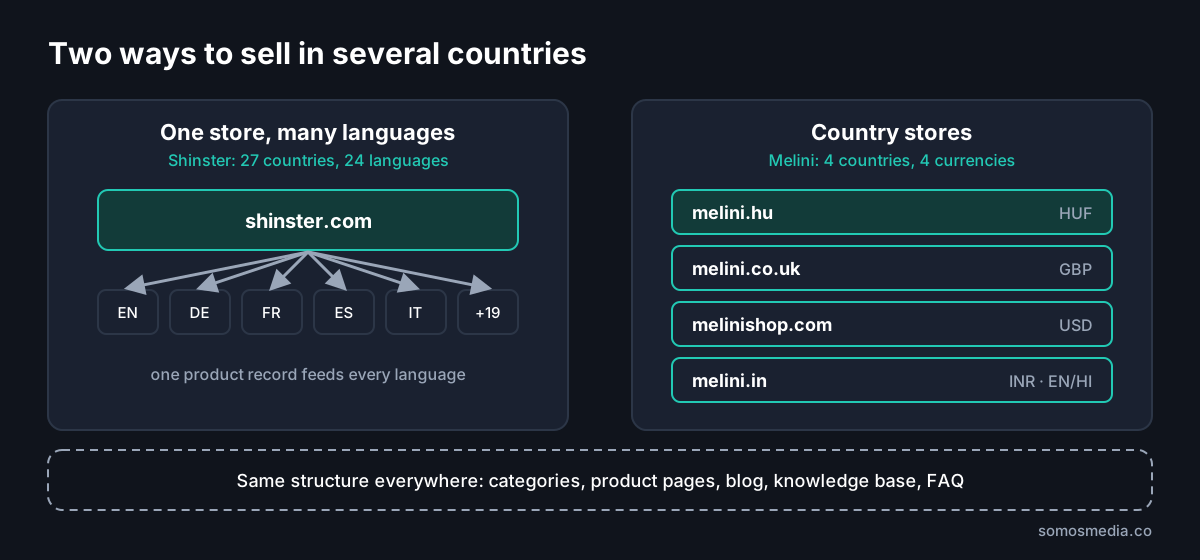
Melini uses country stores: melini.hu, melini.co.uk, melinishop.com for the US and melini.in for India, each with local currency and pricing. Shinster uses one store with many languages, because it sells one configurable product everywhere.
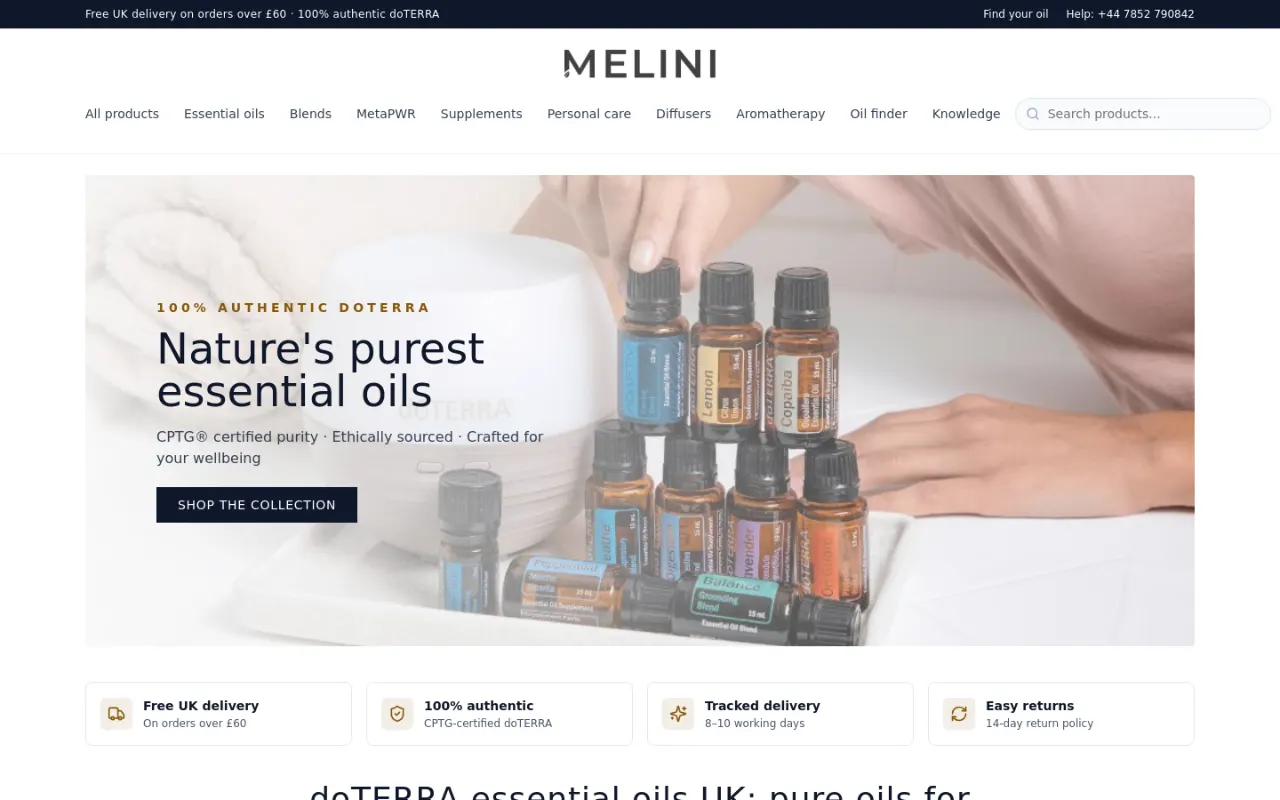
The English version of the Melini webshop. Screenshot: 19 October 2026.
Neither is right for everyone. The question is whether your prices, range and legal setup differ by country. If they do, country stores. If not, one store with language versions is simpler to run.
What each market needs
Prices and currency
Show prices in the buyer's currency, not converted at checkout. Melini runs four currencies: HUF, GBP, USD and INR. Decide whether prices follow exchange rates or are set per market; most brands set round local prices for their main products.
Local search terms
The same product is searched for with different words in different countries. On Melini, titles use the local term, for example “doTERRA essential oils UK” on the UK store and “Price in INR” on the Indian store. We research keywords per market, never by translating the home market's list. Our international SEO work starts here.
Language, sometimes more than one
Some countries need two languages. melini.in runs in English and Hindi. In Switzerland or Belgium, one language rarely covers everyone.
Legal pages, payment and shipping
Privacy, terms, returns and imprint for each market; payment methods buyers know; shipping times and costs stated in their currency. These pages are dull to write and are often the reason a foreign buyer does not trust a store.
Trust signals
Local contact details, local prices and content in their language make a shop based in another country easier to trust. Reviews from that market help most.
The same structure in every store
On Melini, every store has the same proven structure: product categories, product pages, an essential oil finder, a blog, a knowledge base, buying guides and an FAQ. When something works in one market, we can repeat it in the others.
That is the biggest saving in international ecommerce: build the structure once, localise the content per market.
The workflow that makes 24 languages possible
On Shinster, one product record feeds every localised product page, instead of 24 separate copies. AI drafts the localised product copy and meta descriptions from the master record, and a person reviews before publishing. The draft and approved states are stored on the record, so we always know what was machine written and what was checked.
The product itself is international by design: buyers design their own shin guard with their own photo in an online configurator, which works the same in every language.
What this workflow avoids is the most common failure in multilingual stores: the home language gets updated, the others fall behind, and after a year half the product pages are out of date.
International ecommerce SEO
- One URL per language or country, with hreflang linking the versions. Our guide to hreflang tags in practice covers setup and checks.
- Local keyword research for category pages and main products.
- Merchant Center feeds per country, with local currency and shipping.
- Search Console per property or country, checked after launch for each market.
- Content per market, chosen by what that market searches for, not translated wholesale.
Running several stores also means several Search Console accounts, several Merchant Center feeds and several sets of rankings. Checking those every week across Melini's four stores became the first routine we automated, and it later grew into our SEO tool, Vistobi.
International ecommerce strategy: where to start
- Pick one or two markets where you can deliver, take payment and handle returns.
- Check demand with local keyword research before building anything.
- Choose the model: one store with language versions, or country stores.
- Set local prices, payment methods, shipping and legal pages.
- Localise the pages that sell first: homepage, main categories, best sellers, checkout.
- Set up measurement per market: Search Console, Analytics and Merchant Center.
- Add markets once the workflow runs, repeating the same structure.
Frequently asked questions
What is international ecommerce?
Selling online to customers in other countries, either from one store with language and currency versions, or from separate country stores. It covers localisation, pricing, payments, shipping, legal pages and search in each market.
Should I use one store or separate country stores?
One store with language versions is simpler if prices, range and legal setup are the same everywhere. Country stores fit when those differ by market, as with our Melini stores in Hungary, the UK, the US and India.
How do I do SEO for an international store?
Give each language or country its own URLs, link them with hreflang, research keywords per market, set up Merchant Center feeds per country, and check Search Console per market after launch.
Further reading
- Melini case study: four country stores and a partner network
- Multilingual website: what a 5-language site really needs
- Hreflang tags in practice
- E-commerce SEO: what to optimise first
Planning to sell in more countries? See our web development and international SEO services.