
In short
Answer engine optimization (AEO) means making your business the source that AI answer engines quote. Those engines are ChatGPT, Perplexity, Google AI Overviews and Copilot. Classic SEO wins a blue link. AEO wins the sentence inside the answer, and ideally the link next to it.
AEO is not a replacement for SEO. AI answers are built mostly from pages that search engines can already crawl, understand and trust. In practice AEO is SEO with a sharper focus: clear answers, clean structure, and a brand that other sites mention.
AEO, GEO and SEO: what is the difference?
| SEO | AEO | GEO | |
|---|---|---|---|
| Goal | Rank a page in the search results | Be the direct answer to a question | Be cited in generated AI answers |
| Where it shows | Google and Bing results | Featured snippets, voice assistants, AI answers | ChatGPT, Perplexity, Google AI Overviews and AI Mode |
| Main levers | Relevance, links, technical health | Question-and-answer content, structure, schema | Citable facts, brand mentions, crawlable content |
| How you measure it | Rankings, clicks in Search Console | Snippet ownership, answer share | How often AI answers mention and link you |
The terms overlap and are often used as synonyms. In this guide, AEO covers both: optimizing for answers, whether a person reads them in Google or in a chatbot.
How answer engines choose their sources
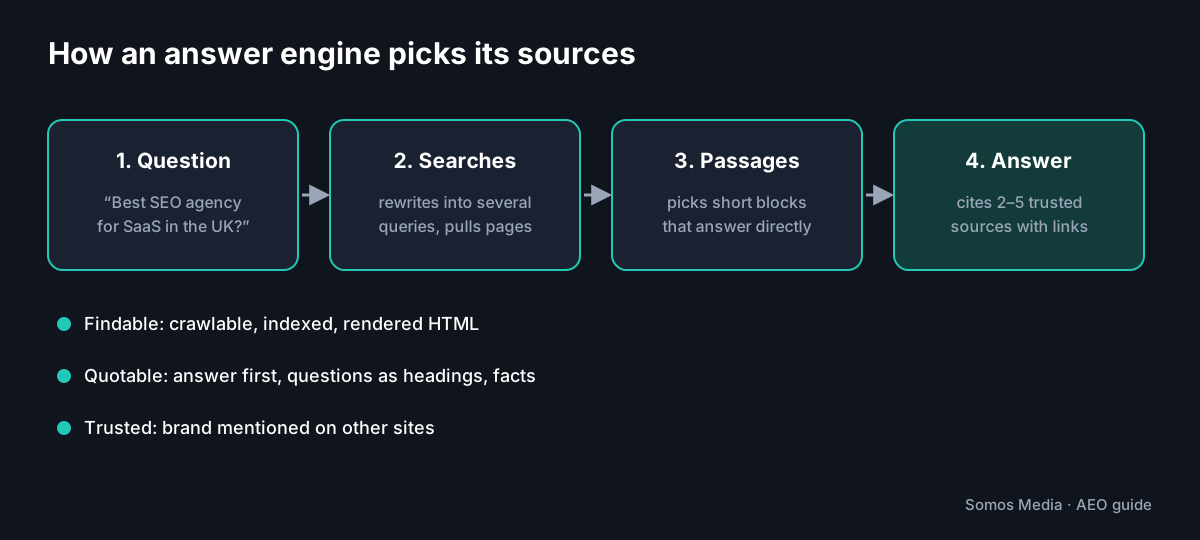
The exact systems are not public, but the pattern is consistent across ChatGPT search, Perplexity and Google's AI features:
- The question is rewritten into searches. The engine turns one prompt into several queries, often more specific than the original.
- Candidate pages are retrieved. Usually from a search index, so a page that is not indexed or not crawlable is out before the race starts.
- Passages are picked, not whole pages. The engine looks for a short block that answers the sub-question directly.
- Trusted sources are preferred. Pages from brands that other sites mention, with clear authorship and up-to-date facts.
- The answer is written and some sources are cited. Often only two to five links make it into the final reply.
So the work splits into three parts: be findable, be quotable and be trusted.
1. Be findable: technical basics
- Let AI crawlers in. Check robots.txt for OAI-SearchBot, ChatGPT-User, PerplexityBot, ClaudeBot and Google-Extended. Blocking them by accident is common after a security plugin or CDN change.
- Serve the content in the HTML. Many AI crawlers do not run JavaScript. If your page is a JavaScript app, make sure crawlers receive a rendered version with the text, title and links. We check our own site this way after every larger release.
- Keep it indexed in Google and Bing. ChatGPT search and Copilot lean on Bing's index, and Google's AI features use Google's. Submit your sitemap to both.
- Add an llms.txt file. It is a plain Markdown summary of your site with links to the most important pages. It is optional and not an official standard, but it is cheap to add.
2. Be quotable: write answers, not just pages
- Answer first. Put a two to three sentence answer directly under each question heading, then the details.
- Use the words people ask in. "How much does an SEO audit cost?" works better than "Pricing considerations".
- One question per section. A clear H2 or H3 with a self-contained answer is easy to lift into a reply.
- Tables and lists for comparisons. Engines reuse them almost as they are.
- Concrete facts. Prices, time frames, steps and named examples. Vague claims are not quotable.
- FAQ and structured data. FAQPage, HowTo, Product, Organization and LocalBusiness schema do not guarantee a citation, but they remove ambiguity about what the page says.
- Keep it current. Show a last-updated date and refresh facts that change, such as prices or tool features.
3. Be trusted: the brand signals AI picks up
- Mentions on other sites. Reviews, directories, partner pages, podcasts and articles that name your brand next to your topic. AI answers tend to recommend brands that are discussed elsewhere, not only on their own site.
- Consistent entity data. The same company name, address, services and description on your site, Google Business Profile, LinkedIn and directories.
- Clear authorship. Real names, roles and experience on articles and case studies.
- First-hand evidence. Case studies, screenshots and your own data. These are what generic AI-written pages cannot copy.
How to measure AEO
Search Console does not show AI answers separately yet, so combine three signals:
- A fixed set of questions, checked monthly. Ask ChatGPT, Perplexity and Google the 10 to 30 questions your buyers ask, and record whether you are mentioned, linked or missing. Tools such as Vistobi's AI visibility check automate this.
- Referral traffic from AI tools. In GA4, look for sessions from chatgpt.com, perplexity.ai, copilot.microsoft.com and gemini.google.com.
- Branded searches. People who see your name in an AI answer often search for it afterwards.
An AEO checklist for your next page
- The page answers one main question, and the answer is in the first paragraph.
- Headings are real questions or clear topics.
- Facts are specific and dated.
- FAQ section with schema where it fits.
- Rendered HTML contains all text and links (check with a crawler user agent).
- AI crawlers are allowed in robots.txt.
- The page links to your service and case study pages, and they link back.
- At least one outside source mentions the brand for this topic.
When you need help with AEO
If your site is small and you have time, the checklist above covers most of it. Bring in help when the technical side blocks you (JavaScript rendering, multilingual sites, migrations), when you need content at scale in several languages, or when you want answer share tracked month by month. AEO is part of our SEO services and our international SEO work, not a separate package.
Frequently asked questions
What is answer engine optimization?
Answer engine optimization (AEO) is the practice of structuring content and building brand signals so that AI assistants and search features quote your business as the answer to a question, ideally with a link.
Is AEO different from SEO?
AEO builds on SEO. Rankings, crawlability and authority still decide which pages answer engines can use. AEO adds a focus on direct answers, question-based structure, schema and mentions on other sites.
How long does AEO take to show results?
Technical fixes, such as unblocking crawlers or rendering content for bots, can change AI answers within weeks. Brand authority builds over months, like classic SEO.
Do I need an AEO agency?
Not always. Many businesses can do the basics themselves. An agency helps when you need technical fixes, content in several languages, or regular tracking of how often AI answers mention you.