
In short
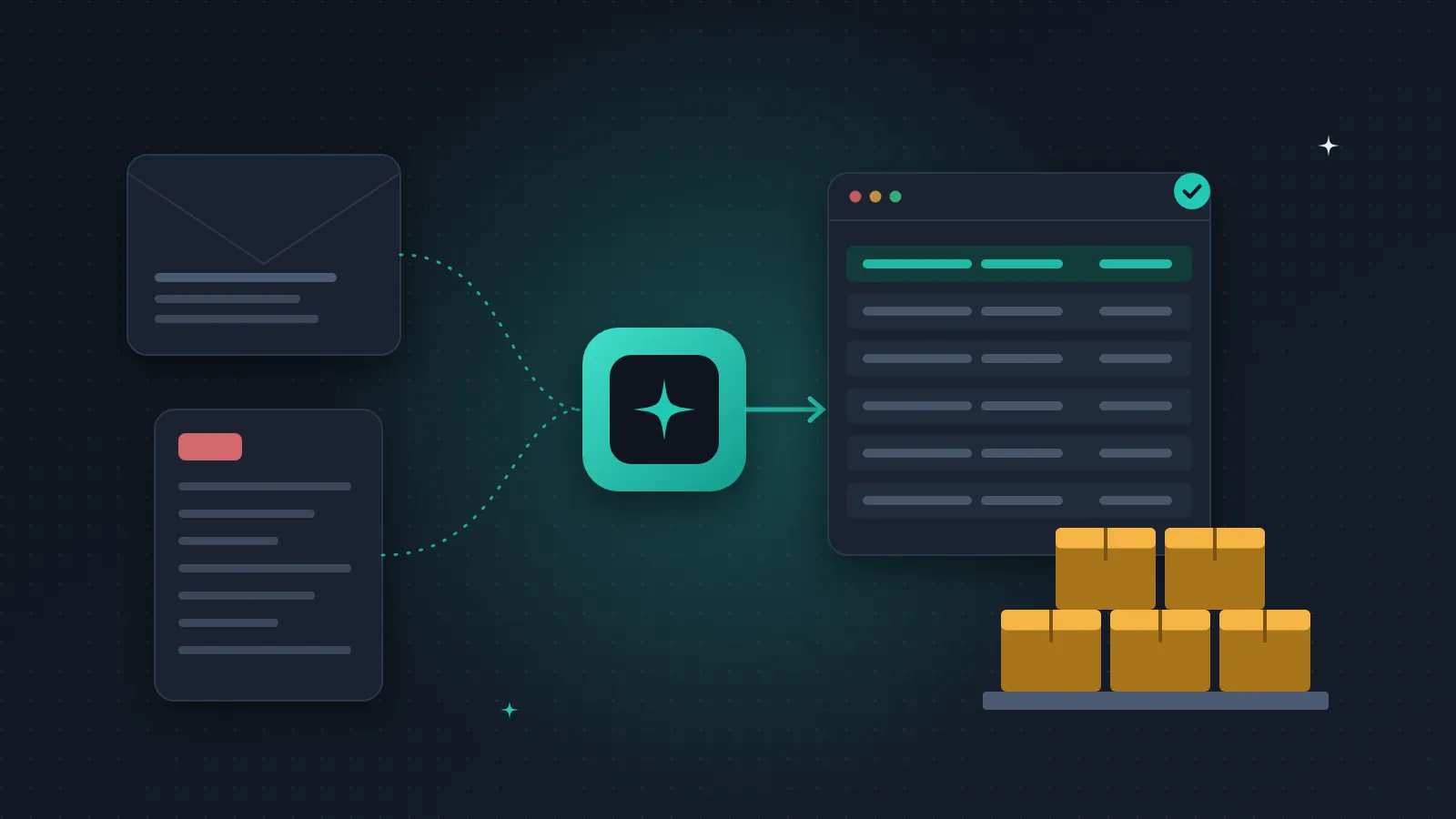
When I talk to wholesale distributors, the same picture comes up again and again: orders arrive by email, PDF and phone, customers ask about stock and prices all day, and someone in sales retypes it all into the ERP. That repetitive part is where AI helps most. It reads the order, checks it, enters it and answers the routine questions, while your team approves the exceptions and spends its time on customers.
Why I would automate order entry first
In most distribution businesses orders still come in mixed formats: a PDF purchase order from one customer, an Excel sheet from another, a free-text email from a third ("same as last month, plus 20 of the blue ones"). Someone reads each one and types it in. It's slow, it produces errors, and it gets worse exactly when business is good.
An AI order-entry system:
- Reads every incoming order from email attachments or the message text.
- Extracts customer, items, quantities and delivery date, even when the customer uses their own product names.
- Matches the lines to your item master and price list.
- Writes the order into the ERP, or prepares it for one-click approval.
- Flags the exceptions: unknown items, price differences, quantities far from the customer's usual order.
Your team stops typing and starts checking.
The principle is the same one we used on the Agrider machinery dealer site: the stock there loads from an XML feed rather than being typed in by hand, across five languages. Once data flows in automatically, people only deal with what actually needs a decision.
Other AI use cases for distributors
- Stock and price questions. An assistant answers "do you have X in stock?" and "what is my price for Y?" from live ERP data, by email or on your website, in the customer's language.
- Order status and delivery questions, answered automatically with tracking details.
- Quote requests for larger or project orders, drafted from your price logic for a salesperson to approve.
- Product data. Supplier data cleaned, and descriptions written and translated for your webshop or B2B portal.
- Re-order reminders. Customers who usually order every month and haven't done so get a timely, personal nudge.
What you need before you start
- Access to your orders: a shared mailbox or folder where orders arrive.
- An item master with your product codes, ideally with the alternative names customers use.
- A way to write into the ERP: an API, an import file or, as a first step, a prepared order a person pastes in.
You don't need to replace your ERP or change how customers order.
What it costs
Our AI projects start from €2,500, plus a monthly running cost that depends on order volume. The timeline depends mostly on how many order formats you have and how your ERP can be reached, so before giving a price I always want to see a sample of real orders: how many arrive, in which formats, and where the time goes today.
My advice is to start with one mailbox and the formats that make up most of your orders. A smaller first version that works is worth more than a big one that is still being tested months later.
Common mistakes
- Trying to automate every format at once. Start with the three or four formats that cover most of your orders.
- Skipping human approval. Keep a person approving orders until you know the error rate. We build our own AI tools the same way: in our outreach system the AI reads incoming replies, and in Vistobi it drafts social posts, but anything that goes out still passes a clear rule or a human check.
- Forgetting the customer's product names. The system is only as good as the mapping between what customers write and your item codes.
FAQ
Can AI really read messy order emails?
Yes. Current language models handle free text, tables and PDFs well, as long as they can match lines to your item master. Unclear lines should go to a person instead of being guessed.
Will our customers notice?
Only in how fast they get a confirmation. They keep ordering the way they always have.
Does it work with our ERP?
Most ERPs have an API or an import format. If yours has neither, the system can prepare the order for one-click entry while a direct link is built.
Related reading
- AI in manufacturing: 7 practical use cases for SMEs
- AI agents for business: 10 use cases that pay off
- AI automation costs and ROI for small businesses
If order entry eats hours of your team's week, have a look at our AI automation services and tell me how your orders arrive today.