 Skip to content


When your website’s traffic suddenly drops, I don’t just see it as a specialist — I feel it as a person too. I know how unsettling it can be. But there is always a tangible reason behind an organic decline, and it’s something we can uncover together. In this article, I’m not promising a perfect, one-size-fits-all solution. Instead, I’m sharing a real, personal approach: how I start the diagnosis, what I focus on most, and how you can gradually turn the decline back into stable growth.
Quick diagnosis: the type and true severity of the decline
In Search Console → Performance view:
- Period comparison: I always compare the 14 days before the update with the 14 days after it, because this gives the clearest picture of the actual change.
- Impressions vs. clicks: if impressions drop, it usually indicates a ranking issue; if CTR falls, it’s most often due to title/meta problems or a mismatch in search intent.
- Where does the drop appear? I review the Web/Image/Video/News views separately, because sometimes only one surface is affected — and that tells a lot about the nature of the issue.
- Small or significant drop? moving from position 2→4 is normal fluctuation, but a shift from 4→20+ clearly signals the need for a deeper content or technical investigation.
Timing and updates: when did the decline begin?
Note the first day of the decline, and check whether it coincided with a broader algorithm update or a spam update. The pattern helps you determine whether it’s a site-wide issue (e.g., trust, quality) or a URL-level problem (e.g., search intent mismatch).
The six most common causes
When I’m looking for the cause of a traffic drop, there are always a few signals that almost immediately point me in the right direction. These are the typical patterns I’ve seen recur across projects over the years — and when one of them appears, it’s already half of the diagnosis.
- People-first shortcomings: this often happens when the content becomes templated, overly keyword-focused, and starts to feel “SEO-ish.” In these cases, it usually lacks real, unique value for the user.
- E-E-A-T weaknesses: if the author or expert isn’t clearly indicated, the business information is vague, or credible references are missing, Google interprets this as a loss of trust.
- Intent mismatch: many times the promise of the headline doesn’t match what the content actually delivers. This drift from user intent can strongly impact CTR and rankings.
- Outdated content: if an article contains old data, hasn’t been updated in over 12 months, or lacks visual elements, it quickly falls behind fresher competitors.
- Technical issues: one of the most common underlying causes of performance declines. This includes crawl errors, indexing problems, Core Web Vitals issues, mobile UX problems, canonical conflicts, and 404/301 redirect chains.
- Link profile re-evaluation: when weak or irrelevant backlinks lose their value, or internal linking is insufficient, the site’s authority can weaken — which directly contributes to ranking drops.
Technical audit checklist
When assessing the technical state of a site, I always aim to quickly clarify whether there are any fundamental issues that could, on their own, hold back performance. These are the areas where even the smallest deviation can have a measurable impact, so I review the following points consistently:
- Indexing: in the Coverage report, I check whether an important URL has accidentally been set to noindex, or if there’s a robots.txt rule blocking crawling.
- CWV (Core Web Vitals): I look at the LCP, CLS, and INP thresholds, paying special attention to mobile performance, since issues tend to appear there first.
- Canonical tags: it’s essential that every page has a clear canonical tag and no duplicate versions that could confuse Google.
- Internal 404/301 issues: short, clean redirect paths help maintain stable crawling and prevent unnecessary slowdowns.
- Schema markup: where relevant, I apply structured data such as FAQ, Product, Article, or LocalBusiness, as these support richer visibility in search results.
- Language markup: on multilingual sites, I closely check hreflang pairs and ensure a consistent URL structure to avoid Google showing the wrong page version.
Content and E-E-A-T enhancement
When improving content, I always look for ways to make a page more trustworthy, more valuable, and clearer — both for users and for Google. These are the key aspects I review whenever I’m investigating a content-related or E-E-A-T-driven decline:
- Author credibility: it’s essential that the author’s name, professional background, relevant references, and the content’s latest update date are clearly visible. Together, these form the foundation of trust signals.
- Unique value: I always recommend using your own data, case studies, images, videos, or diagrams. These are the elements that give the content real differentiation and authority.
- Structure: clear H2/H3 headings, tables, lists, and shorter paragraphs not only improve the user experience, but also help Google better understand the content.
- Sources: linking to credible manufacturer pages or statistical sites strengthens professional reliability and signals expertise.
- Local signals: where relevant, displaying the address, phone number, opening hours, and a map all contribute to stronger local trust indicators.
- Page-level intent: every URL should serve one primary search intent. If a page tries to answer multiple directions at once, Google perceives it as less focused and less reliable.
Link profile and internal linking
When reviewing internal and external linking, I always focus on how to give Google stronger thematic signals. These are some of the elements that are crucial in every recovery process.
- Topic clusters: it’s important to create a clear structure where supporting articles are connected to a central pillar page. In each article, I usually include 3–8 internal links to make the topical depth visible.
- Anchor texts: internal link anchors should be natural and varied; relying only on exact-match anchors often weakens rather than strengthens the signals.
- Fresh backlinks: partnerships, press mentions, and industry directories can all be valuable if they come from high-quality sources. Low-quality links, however, are worth avoiding because they can easily hold the site back.
- Orphan pages: I regularly identify URLs that receive only 0–1 internal link. I always reintegrate these pages into the content structure so that Google can better understand and evaluate them.
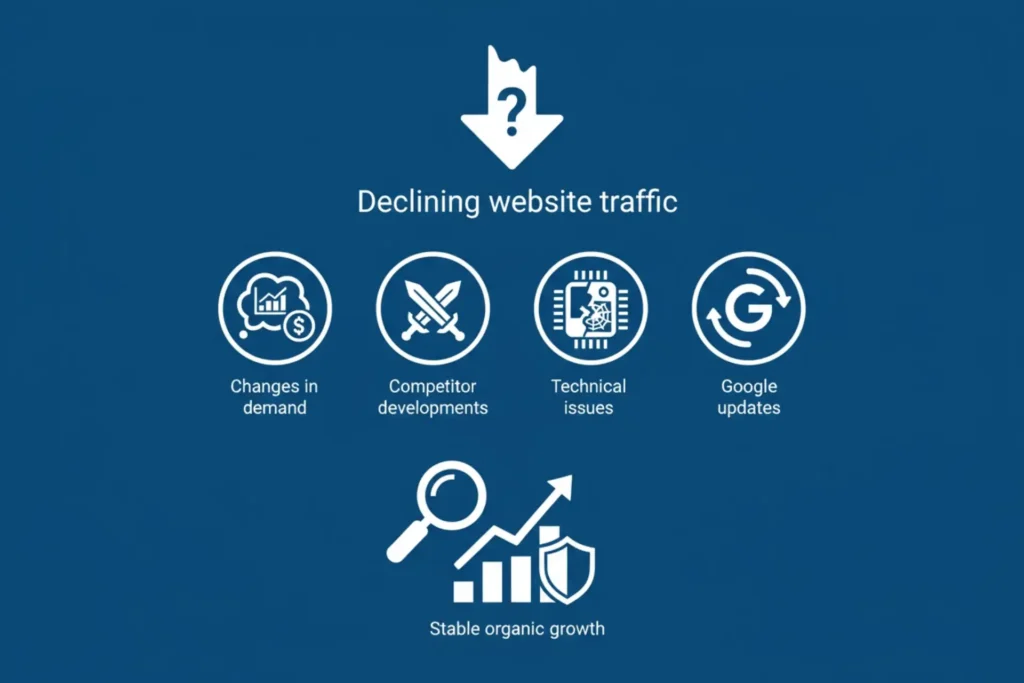
30–60–90 day recovery plan
0–30 days: Diagnosis and quick wins
- Analysis of the top 10 declining URLs: in this phase, I thoroughly review the queries, position changes, and CTR trends, because these metrics show most clearly where the drop actually started.
- Fine-tuning titles and meta descriptions: I align them with the real search intent so the user gets exactly what they expect — this alone can often improve CTR.
- Fixing critical technical issues: I start by checking indexing, Core Web Vitals, canonical tags, and 404 errors, as any one of these can independently hold back organic performance.
- Partial updates to 3–5 key URLs: on the most important pages, I refresh the data, visuals, and references to quickly make the content relevant and up to date again.
31–60 days: Deep content development and E-E-A-T enhancement
- Pillar and cluster structure development: I build pillar pages around the main topics and then connect the supporting cluster articles to them. This structure provides Google with clear topical signals.
- Publishing author profiles and guidelines: at this stage, I create author bios, editorial guidelines, and a referencing policy. Together, these strengthen E-E-A-T signals and make the origin of the content fully transparent.
- Rewriting or expanding 5–10 supporting articles: I update the related articles and integrate them with internal links so the thematic relationships and the depth of coverage become clearly visible.
61–90 days: Authority building and fine-tuning
- Natural backlink campaign: in this phase, I focus on creating content such as case studies or data visualizations, because these are the types of assets other websites are more likely to link to. This is one of the safest and most effective ways to build high-quality backlinks.
- SERP comparison: I compare the top-ranking competitors’ content and identify where the content gaps are. I then fill these gaps strategically to ensure the site covers every relevant search intent.
- CTR testing and refinements: testing different title variations, optimizing images and alt texts, and expanding structured data all help the site not only rank well but also achieve a higher click-through rate.
Measurement framework
- Leading indicators: these include impressions, average position, the number of indexed URLs, and Core Web Vitals metrics. These provide the earliest signals of whether your interventions are starting to work.
- Lagging indicators: organic clicks, conversions, and revenue respond more slowly, but they reveal the actual, long-term results.
- Timing: after any major change, it’s best to wait at least a week before evaluating the data, and then compare results week over week. This prevents drawing conclusions based on short-term fluctuations.
If you follow the steps outlined in this article — from the initial diagnosis to the content and technical improvements, all the way through strengthening E-E-A-T and implementing the 30–60–90 day recovery plan — you’ll essentially be walking the same path I use in client projects. This process is data-driven, transparent, and proven to work: first it stabilizes your organic performance, then gradually rebuilds visibility and key metrics. If you apply every step consistently, your impressions, rankings, CTR — and eventually your conversions — will all improve. That’s because search engines reward exactly what you’ll be building: a technically sound, thoughtfully structured, credible, and genuinely valuable website.
Can we help?
Ha bizonytalanná tett a forgalom visszaesése, nem kell egyedül megküzdened vele. Segítünk tisztán látni, mi okozta a problémát, és hogyan lehet lépésről lépésre helyrehozni. Ha nem tudod mit kell tenned, tudunk segíteni.
Frequently Asked Questions (FAQ)
- Is my website traffic dropping? What’s the first step?
Open the Search Console Performance Report, compare two consecutive two-week periods, and determine whether you’re dealing with a ranking drop or a CTR decline. - How do I know if a Google algorithm update caused the issue?
Check the exact start date of the drop and compare it with the official update timelines. If the drop is site-wide and the dates match, the connection is likely. - When can I expect to see improvements after making changes?
Smaller adjustments can show effects within a few days, but content and trust-related recalculations take weeks or even months to rebound. - Should I mass-delete weak content?
Only as a last resort. First, try updating, expanding, and aligning the content with a clear search intent. Deletion is recommended only if the page cannot be saved. - How can I strengthen credibility quickly?
List the authors and their expertise, add citations to reputable sources, and make company/contact information clearly visible. - How does internal linking help with recovery?
It provides strong thematic signals to Google, improves crawlability, and helps distribute authority across your most important URLs.
