
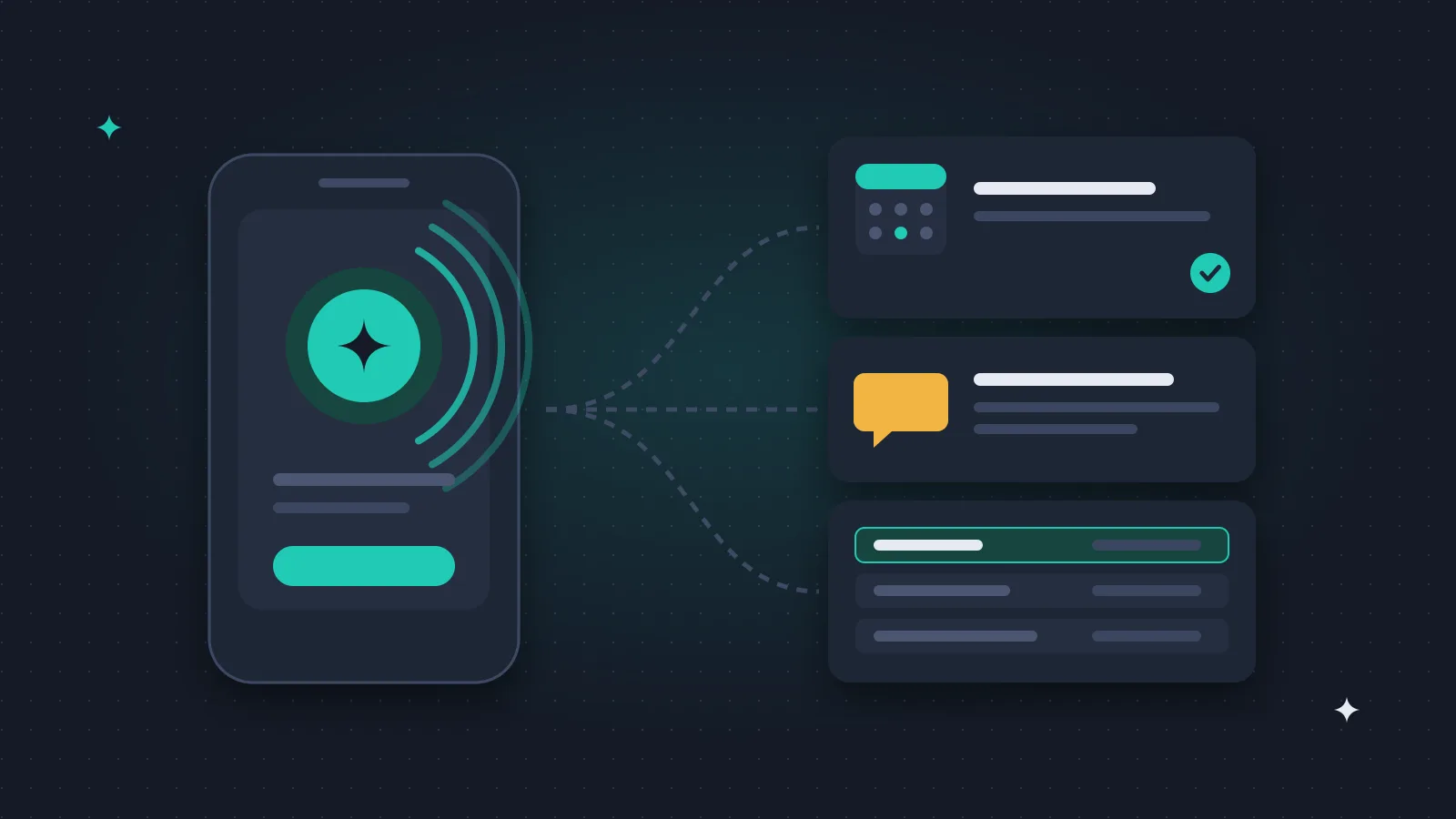
Most small businesses do not have a phone problem. They have a missed-call problem. The phone rings while you are on a job, in a meeting or at lunch, and the caller rings the next company on the list. An AI receptionist is a voice agent that picks up those calls, talks to the caller in natural language and does something useful with the conversation.
I look at it the way I look at any AI project: start from where the time and the money actually leak, then decide whether AI is the right fix. Sometimes it is. Sometimes a voicemail-to-text and a callback rule are enough.
What an AI receptionist can realistically do
- Answer every call, 24/7, including evenings, weekends and when every line is busy.
- Answer routine questions from verified information: opening hours, service area, rough price ranges, how to prepare for an appointment.
- Book, move or cancel appointments directly in your calendar or booking system.
- Take a structured message: name, number, what they need, how urgent it is, and send it to the right person by email, SMS or into your CRM.
- Qualify and route: a new enquiry goes to sales, an existing customer to support, an emergency to the person on call.
- Work in several languages, which matters a lot for businesses with international customers.
What it should not do
- Give advice where a wrong answer has consequences (medical, legal, financial) without a human check.
- Quote binding prices for custom work.
- Pretend to be a person. Callers should know they are talking to an AI, and in the EU this is now a legal requirement (see below).
- Trap angry or confused callers in a loop. There must always be a way to a human or a callback.
Where it pays off first
The businesses that gain most have three things in common: many inbound calls, staff who cannot pick up while working, and a call that is worth real money.
- Trades and home services: plumbers, electricians, HVAC, roofers. The person who could answer is on a ladder.
- Clinics and practices: dentists, physiotherapists, vets. Booking calls crowd out everything else at the front desk.
- Salons, studios and repair shops: short calls, mostly about availability.
- B2B dealers and distributors: parts and stock enquiries outside office hours, often from other countries.
A quick test before you buy anything: count last month's missed calls and estimate how many would have become jobs. If that number times your average job value is bigger than the monthly cost of the tool, it is worth trying.
Ready-made tool or custom build?
This is the decision that matters most, and the honest answer is that for many small businesses a ready-made tool is enough.
| Ready-made AI receptionist | Custom-built voice agent | |
|---|---|---|
| Set-up time | Hours to days | Weeks |
| Pricing | Monthly subscription, often with included minutes | One-off build plus running costs per minute |
| Fits when | Standard booking, FAQs, messages | Calls must connect to your own systems and rules |
| Integrations | Popular calendars and CRMs | Anything with an API: stock, quotes, ERP, custom CRM |
| Control over data and logic | Limited to the vendor's settings | Full |
Choose a ready-made tool when your calls are mostly bookings and FAQs and you already use a calendar or CRM the tool supports.
Consider a custom build when the call has to look something up or create something in your own systems: check stock for a part number, prepare a quote request, look up an order, apply your own routing rules, or work across several languages with your own vocabulary. That is the same kind of work as the rest of our AI systems: the voice is only the front door, and the value is in what happens behind it.
How pricing usually works
Ready-made tools are almost always priced per month, with a number of included call minutes or calls and a charge above that. When you compare offers, check:
- what happens when you go over the included minutes;
- whether booking, CRM sync and multiple languages are in the base plan;
- whether calls are recorded and transcribed, and where that data is stored;
- how easy it is to leave, and whether you can export call logs.
A custom set-up has a one-off build cost plus running costs for the phone line, speech recognition, the voice and the language model, usually per minute. Our article on what an AI agency costs explains how such projects are priced in general.
Legal and trust points to check before going live
- Tell callers it is an AI. The EU AI Act requires AI systems that interact with people to make that clear, with these transparency rules applying from August 2026. A short opening line is enough.
- Recording and transcripts. If calls are recorded or transcribed, you need a legal basis under GDPR and should say so at the start of the call.
- Data location and access. Know where transcripts are stored, who can read them and how long they are kept.
- A human fallback. Define what happens when the AI is unsure, the caller asks for a person, or the matter is urgent.
How to introduce it without annoying customers
- Start with overflow only. Let the AI take calls you would miss anyway: after hours and when lines are busy.
- Give it a narrow job. Bookings and messages first. Add more only after you have read the transcripts for a few weeks.
- Measure. Missed calls before and after, bookings made by the AI, calls passed to a human, and complaints.
- Read the transcripts. They show what customers actually ask, which is useful far beyond the phone, for your website and FAQ too.
I apply the same rule we use in our own systems: a narrow, checkable task works reliably, a vague one does not. When an AI reads the replies to our outreach emails, it does one thing: decide whether someone is interested or wants to be removed. That is why it works.
Summary
An AI receptionist is worth it when missed calls cost you real jobs. For standard bookings and FAQs, a ready-made tool is usually the fastest and cheapest start. When calls need to talk to your own stock, quote or CRM systems, a custom voice agent makes more sense. If you are not sure which side you are on, tell me how your calls work today and I will tell you what I would try first.